Tamura Shihan trained and first taught in Japan, as an uchideshi of O-Sensei. From 1964 he spent the rest of his life in Europe, based in France, and became one of the people most responsible for the spread of aikido across the continent. Much of what he passed on lives in the memories of those who trained with him. This book sets out to gather those first-hand memories alongside the documentary record, so that they are not lost with time. It will tell his story, how he understood aikido, and how he practiced it.
“I began researching Tamura Shihan after coming back to active aikido practice following over a decade away. When I returned, I did not find the approach I had known and loved. As I went looking for it, I realized how little had been written about Tamura Shihan, and that some of the people who knew him were no longer with us. Aikido is not static, but I missed what had been lost.
“It took me a while to find my path again, and I found it in the teaching and lineage of Tamura Shihan. From then on I set out to gather everything I could about him, and I felt it my duty to share it with anyone interested. That was the beginning of this biography.”
Share your story
If you have direct personal experience of Tamura Shihan, on the mat or off it, we would be grateful to hear from you. Please tell us:
when and where you met or trained with him;
specific memories: a seminar, a correction, a conversation, a phrase he used;
letters, programs, notes or photographs you made or hold, and who owns the rights to them;
corrections to dates and facts on this site, with a source.
You may write in English, Portuguese, French, Spanish or Japanese.
Your privacy
Nothing you send will be quoted, published or passed on without your explicit permission. You can ask to be credited by name or to remain anonymous, and you can withdraw your contribution at any time.
The FFAB’s 2010 tribute describes Tamura as the author of three books: two technical works, now out of print, and Étiquette et transmission, “on the spirit and the heart of aikido”.[14][37]
Nobuyoshi Tamura, with Guy Bonnefond; preface by Kisshomaru Ueshiba
Publisher
Publisher recorded differently: AGEP, Univerpress, or Chancellerie européenne de l’Aïkido So Hombu
First published
1975 (some bibliographies give 1977) uncertain
Language
French
Translations
(“Aikido – National method”; no translation known)
ISBN
None found
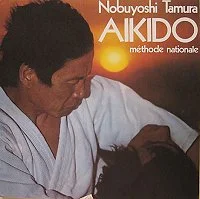
A technical manual (about 260 pages) presenting the national method of aikido that Tamura developed for French teacher training. A deluxe edition exists, bound in full natural linen. According to its colophon, the first printing was completed on 30 April 1975 by AGEP, Marseille, with 50 numbered “grand luxe” copies reserved for figures from the Éducation Nationale and the martial arts world, 2,500 cloth-bound “grand luxe” copies with a color dust jacket, and 3,500 softcover copies. Photos are by Pierre Juniet, with a few by Akihiro Tamura.[1][41][37][63]
In France, aikido has state grades and state teaching diplomas. A state exam needs an official reference describing what is expected, so the authorities required a single national method of aikido. Tamura developed it with André Nocquet and Mochizuki (Minoru, according to the FFAB; Hiroo, according to Aikido Journal) in 1973–74 (other sources give 1973 or 1975) uncertain. It became the reference for examinations in the Union Nationale d’Aïkido (UNA, founded 1974). The book followed in 1975 (some bibliographies give 1977).[54][15][14][6] Some also see it as a strategic step during the reunification of the French federations, when publishing the national method first could secure a leading place in French aikido. Pierre Chassang may also have encouraged or helped with the project.
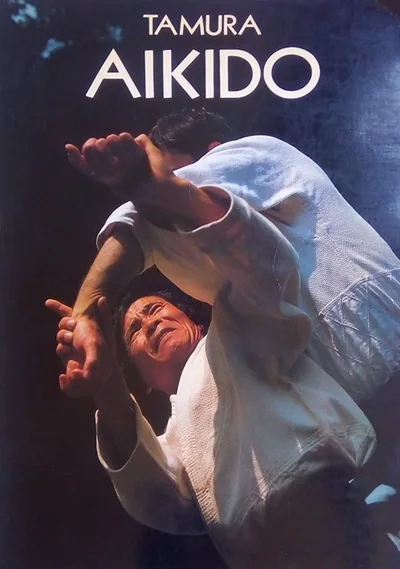
A technical book, now out of print. Its introduction explains how Japanese budo approaches study, starting from origins and seeing things as a whole. A deluxe edition also exists, hardbound in black with a calligraphy cover.[2][42][37][14]
Tamura writes that the Western way of studying (taking things apart) differs from the Japanese way (starting from the whole). He explains budo’s origins so that people learning aikido do not set out on a path “long et dur” in vain.
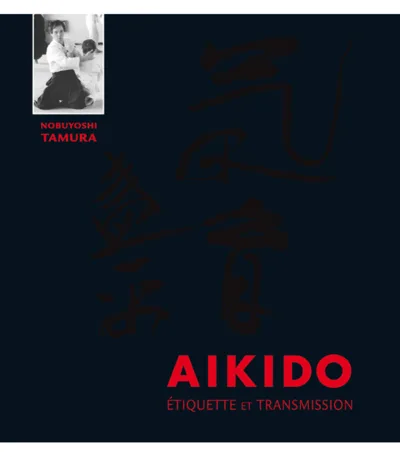
Aïkido – Étiquette et transmission : manuel à l’usage des professeurs
Author(s)
Nobuyoshi Tamura; translated from Japanese by Stéphane Benedetti
Publisher
Éditions du Soleil Levant, Aix-en-Provence (1991); re-issued by Budo Éditions (2002)
First published
1991
Language
French (original Japanese text translated)
Translations
English (online): “Aikido – Etiquette and Transmission”; Italian: “Aikido. Etichetta e disciplina” (Edizioni Mediterranee, 1994, ISBN 978-88-272-0993-6); German: “Aikido – Etikette und Weitergabe” (2007, ISBN 978-3-939703-50-1); Spanish: “Aikido. Etiqueta y transmisión” (Paidotribo)
A handbook for teachers on the role of the teacher, etiquette (rei), the dojo and the transmission of aikido, written primarily for teachers but also for beginners.[1][40][39][42][43][12]
“One has to know clearly where to take the students, which method to use and on which point to focus attention. This is why I have let my pen run on the pages that follow.”
Collected texts
Nobuyoshi Tamura Shihan – son Message, son Héritage, vol. 1: L’esprit Shumeïkan (2015). A posthumous collection of about 150 pages of Tamura’s own texts, from the founding of the Shumeikan in 1992 to 2010, published by the École Nationale d’Aïkido with the FFAB. In French; no ISBN. The royalties go to his family and to the upkeep of the Shumeikan dojo.[62]ENA leaflet